Friday, May 2, 2014

Umer gul

Umer Gul

Umer Gul Biography
he slightest-overvalued but the largest part flourishing and guaranteed Pakistan velocity creation of the preceding only some years, Umar Gul is the most recent in Pakistan’s congregation-line of swiftness-bowling aptitude. He had played just nine first-class matches at what time called up for national duty in the rouse of Pakistan’s deprived 2003 World Cup. On the smooth tracks of Sharjah, Gul performed commendably, maintaining tremendous regulation and being paid appreciable out swing with the new ball.
He is not articulate although bowls an extremely swift profound ball and his outstanding have power over and capability to take out line of stitching movement symbols him out. Auxiliary, his height enables him to haul out bounce on the majority outsides and from his natural back of a length, it is a constructive attribute. His first immense moment in his profession came in the Lahore Test in opposition to India in 2003-04. Unfazed by a intimidating batting line-up, Gul slashed all the way through the Indian top order, affecting the ball both ways off the ridge at a jagged velocity. His 5 for 31 in the first innings gave Pakistan near the beginning proposal which they troop home to win the Test.
Unluckily, that was his final cricket of any kind for over a year as he exposed three pressure fractures in his back right away later than the Test. The wound would have wrecked several an international professions, although Gul came back, fitter and sharper than previous to in late 2005. He came back in a Pakistan shirt in opposition to India in the ODI series at home in February 2006 and in Sri Lanka given an idea about further signs of treatment by permanent both Tests but it was in actuality the second half of 2006, where he completely came of era. Leading the harass in opposition to England and then the West Indies as Pakistan’s main bowlers endured injuries, Gul stood tall, finishing Pakistan’s best bowler.
Since after that, as Mohammad Asif and Shoaib Akhtar have struggled, Gul has turn out to be Pakistan’s forefront and one of the most excellent swift bowlers in the world. He is smart sufficient and good adequate to achieve something in all three set-ups and 2009 proved it: he put collectively a scrap of wicket-taking in ODIs, on departed pitches in Tests (together with a profession-best six-wicket haul in opposition to Sri Lanka) and recognized himself as the world’s most excellent Twenty20 bowler, coming on later than the early overs and firing in Yorkers on demand.
He had oblique at that by being most important wicket-taker in the 2007 World Twenty20; over the after that two years he overwhelmed wherever he went, in the IPL for the Kolkatta Knight Riders and in Australia’s domestic Twenty20 tournament. Corroboration came on the grandest phase: having poleaxes Australia in a T20I in Dubai with 4-8, he was the best bowler and leading wicket-taker as Pakistan won the second World Twenty20 in England. The best part was 5-6 in opposition to New Zealand, the uppermost quality demonstration of Yorker bowling. He is not a one-format pony, on the other hand, and will hang about a vital component in Pakistan’s attack across all formats.


Umer Gul


Umer Gul

Umer Gul

Umer Gul

Umer Gul

Umer Gul

Umer Gul

Umer Gul

Umer Gul

Umer Gul

Umer Gul


Shoib malik

Shoib Malik

Shoib Malik Biography
Malik was ranked second, behind teammate Shahid Afridi, in the ICC ODI all-rounder rankings in June 2008.
International career
He started his career as just an off spinner, and is now regarded as a useful bowling all-rounder with a batting average in the mid 30s in both Test and ODI cricket.
Malik is regarded as a flexible player. He is capable of hitting big shots but is also capable of rotating the strike with good placement. He has a strike rate of 77.23 runs per 100 balls, which compares favorably to players such as Rahul Dravid and Inzamam ul-Haq. His most brazen display of "power hitting" came in 2003 against South Africa when he scored 82 from 41 balls.
As is required of most modern players he also has displayed good defensive batting at times. He has taken over 100 ODI wickets at an average under 35 and economy rate below 4.5. His bowling action has come under scrutiny (particularly his doosra) but he has had elbow surgery to correct this.
In Tests, he has a better batting average against Sri Lanka and South Africa than other nations. In ODIs he has a better batting average against India, South Africa, and the West Indies than his overall career average.
During his Test career, Malik has batted at 5 different positions and he has the unusual record of batting at every position except 11th in ODIs. Pakistan's problems in finding a reliable opening pair have led to Malik being used as an opener in Test and ODI matches.
CaptaincyFollowing Inzamam-ul-Haq's resignation as Pakistan captain after the 2007 World Cup, Shoaib Malik was put forward as one of the names for the captaincy along with Younus Khan and Mohammad Yousuf.
After Younus Khan's rejection, Malik was the popular choice as a younger captain and was seen to represent a fresh start after the Inzamam era.
Former skipper Imran Khan, who led the team to World Cup glory, backed Malik for the role, stating, "He appears to have a good cricket brain and could turn out to be a very good choice for Pakistan cricket."
Malik was appointed Captain on 19 April 2007 by the Pakistan Cricket Board, his experience considering his relatively young age and consistent performances are cited as other reasons for his appointment. His vice-captain was initially Mohammad Asif, followed by Salman Butt, although Younus Khan was recently appointed his deputy when Butt was dropped from the team.
In Malik's first series as captain, Pakistan beat Sri Lanka 2-1 in an ODI series in Abu Dhabi. His next assignments were home Test and ODI series against South Africa which Pakistan lost 1-0 and 3-2 respectively. 3-2 was the score in favour of India when Pakistan subsequently played an ODI series against their arch-rivals. Malik hit 89 and took three wickets in the final match, which Pakistan won by 31 runs.
Younis Khan took over as captain on 27 January 2009.
In 2010, Malik was given a one-year ban from the national team by the PCB, who charged him with causing infighting within the team.
Notable performances
In Test cricket he made a big impression with his match-saving innings against Sri Lanka, in which he batted for the whole day and finished with 148 runs not out. His bowling has been effective at times, especially in one-day cricket where his best bowling figures are four wickets for 19 runs (4/19) in addition to many 3-wicket hauls.
ControversyMalik came under criticism in India for his statement after losing the final of the 2007 ICC World Twenty20.After the match he stated, "I want to thank you back home [in] Pakistan and where the Muslim lives all over the world."
The mother of India's man of the match, Irfan Pathan, a Muslim, said: "Shoaib must have said that for his own countrymen, how can he speak for all the Muslims of the world? The way Irfan and [half-brother] Yusuf played for India, that's all that matters to us.
They have made us proud of the way India won the Cup." He was also criticised by some Pakistani fans for his comments, while others stated that the Indian media was creating a controversy by misinterpreting his statement
Personal life
Malik married Ayesha Siddiqui of Hyderabad India through a telephone Nikah on June 3, 2002. But, in a statement in Karachi on January 21, 2008, Malik claimed that no Nikah had taken place.
Malik said his marriage plans with Siddiqui ended because both families could not reach an understanding on certain issues. "Yes, I had a long relationship with her and we planned to get married". Malik was forced by Siddiqui's family to give divorce after he claimed that there was no formal Nikah between the two in 2008.
Siddiqui's father, M A Siddiqui, had then said that the family would move court if his daughter did not get a divorce. In April 2010, Siddiqui's family released Shoaib-Ayesha 'marriage' certificate (Nikahnama). On April 2, 2010, Malik said he plans to sue Siddiqui's family for indulging in "character assasination".
On April 5, 2010, Malik admitted taking part in a telephone Nikah (marrriage) ceremony and signing the marriage certificate, but said that they are invalid because he never knowingly met her and she sent him photographs of another, more attractive, woman claiming they were her own. On April 7, 2010 Malik confirmed his marriage with Siddiqui and signed the Talaq (divorce) papers.
In 2008, there were media reports that Malik was dating former Miss India and Bollywood actress Sayali Bhagat However, Bhagat later strongly rebuked these media reports as "gossip" and "speculation".
On 29 March, 2010, Pakistani media reported that  Mirza, an Indian tennis player, will wed Malik in April, 2010. This news was confirmed to the media by Imran Mirza, the tennis player's father. Later, Malik also confirmed on his Twitter page that they will get married in April 2010.
On 12 April, 2010, Malik married Mirza in a Muslim ceremony at a hotel in Hyderabad, India for a mahr of Rs. 6.1 million (US$137,500).

 Shoib Malik


 Shoib Malik


Shoib Malik


Shoib Malik


 Shoib Malik


 Shoib Malik


 Shoib Malik


 Shoib Malik


 Shoib Malik


 Shoib Malik


Shoib Malik

Thursday, May 1, 2014

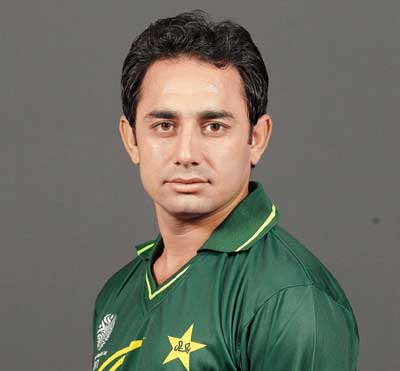
Saeed ajmal

Saeed Ajmal

Saeed Ajmal Biography
Saeed Ajmal is a Pakistani cricketer. He is a right-arm off-spin bowler who also uses the Doosra to good effect.

Early life and domestic cricket
Ajmal has played for Faisalabad since his debut in 1995 at the age of 18, also representing Khan Research Laboratories and occasionally Islamabad. After a successful season in 2007–08 for Khan Research Laboratories, he was named in Pakistan's squad for the 2008 Asia Cup.

In a domestic match Faisalabad vs Rawalpindi , the Pindi coach told ajmal that camera footages could be sent to board . Thus Saeed did not bowl any doosra , as Pindi hampered to a win.

International career
He made his debut against India, taking the wicket of Yusuf Pathan in an eight-wicket before taking two wickets in a ten-wicket victory over Bangladesh, although the team had no chance of progressing to the competition's final.

From there he has had a rapid rise in the team in just over a full year. He had an excellent time at the 2009 ICC World Twenty20, bowling at an economical rate and regularly taking wickets along with his spin partner Shahid Afridi. He was then picked for the Sri Lankan series in Sri Lanka where he had made solid performances in the Test matches, being picked ahead of Danish Kaneria in two of the matches.

Ajmal's good form continued in the 2010 ICC World Twenty20 as he was Pakistan's leading wicket taker. However despite his good form he was known for conceding three sixes to Michael Hussey in what has been hailed as the most thrilling Twenty20 match of all time as Australia were in trouble and Ajmal was the unfortunate bowler who bowled that final over.

Shortly after this the Pakistan team began there long tour of England and in the two Test matches played against Australia spinner Danish Kaneria was selected ahead of him. In the 1st Test against England Kaneria was selected ahead of Ajmal as well. However after poor bowling by Kaneria, Ajmal was selected and he took his career best bowling figures of 5/82 Despite Pakistan restricting England the team suffered a top order collapse and Zulqarnain Haider scored 88 and Ajmal also showed that he has the abiltiy to bat when he scored 50 runs these two men helped Pakistan lead a revival after being bowled out for 72 on the first day. Along with Zulqarnain Haider they together continued to frustrate the England and when it was stumps on day three Pakistan had a 112-run lead however Zulqarnain Haider and Ajmal were out on 88 and 50 respectively and so Pakistan were left on the final wicket with Mohammad Asif and Umar Gul. During the series against England Pakistan became englufed in a spot fixing scandal after the fourth test and in a later secret interview it was unveiled by alleged fixer Mazhar Majeed that Ajmal, Abdul Razzaq, Younis Khan and Shahid Afridi were difficult to bribe. He stated that Ajmal was too religious to get involved into fixing.

Skills in the art of spin
“ "With HawkEye coming in, left-arm spinners slide the ball on for lbws. Offspinners get a lot of lbws from round the wicket, so you [batsman] have to work really hard, and a bloke who's got a doosra you have to work extra special hard. ”
—England batsman Kevin Pietersen

Ajmal is known as an excellent spinner of the ball and strong especially against left-handers. He has a well disguised doosra and keeps it as a mystery while he bowls. His technique is noted for causing more spin than speed as that is what Ajmal prefers Which in a sense is similar to Danish Kaneria who likes to bowl slow spin but Kaneria has a different case as when he picks up more speed he tends to loose the spin of the ball. When Pakistan started there tour of England in 2010 former Pakistani off-spinner and the founder of the doosra, Saqlain Mushtaq had a coaching session with Ajmal to advise him on his spin techniques Ajmal's spin technique came in special hand against England in 2010 has he took his first 5-wicket haul to help restrict England. Kevin Pietersen congratulated Ajmal on the amount of spin he achieved. Ajmal though started his international cricket in limited-overs cricket and was one of the early off-spinners to possess the skills of the doosra. A stat shows that out of Ajmal's 38 wickets in Twenty20 cricket 13 of them have been stumped the most for any bowler in the game. Also it was of Ajmal's off-break that Zulqarnain Haider collected his maiden international stumping.

In 2009, University of Western Australia test indicated that his arm is 8.5° tilted due to accident and 23.5° bowling action is allowed for him. Saeed Ajmal also said in an interview that he had learned the doosra on his own and that the rated Saqlain Mushtaq as the best off-spinner ever and rated Muttiah Muralitharan in second-place. He also stated that Muralitharan was a very nice and down to earth person. Ajmal said that he planned to introduce a new delivery at the 2011 Cricket World Cup

Saeed Ajmal 

Saeed Ajmal 

Saeed Ajmal 

Saeed Ajmal 

Saeed Ajmal  

Saeed Ajmal  


Saeed Ajmal 

Saeed Ajmal 

Saeed Ajmal 

Saeed Ajmal 

Saeed Ajmal 


shahid afridi


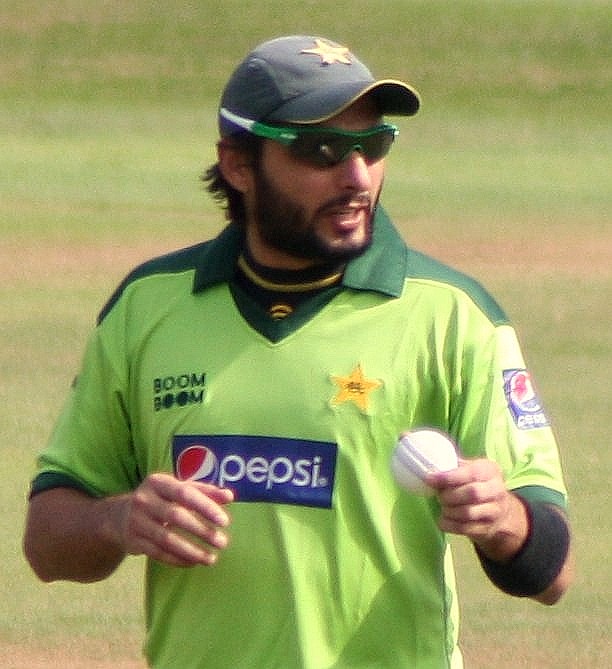
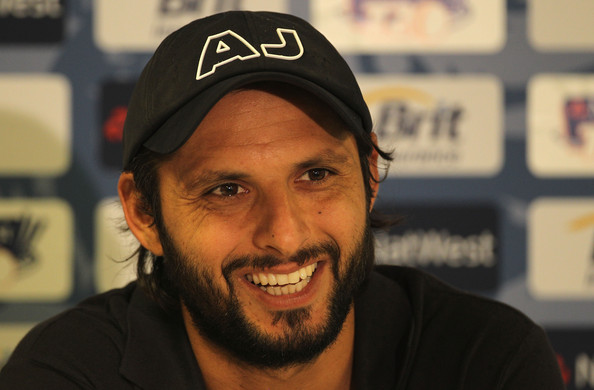
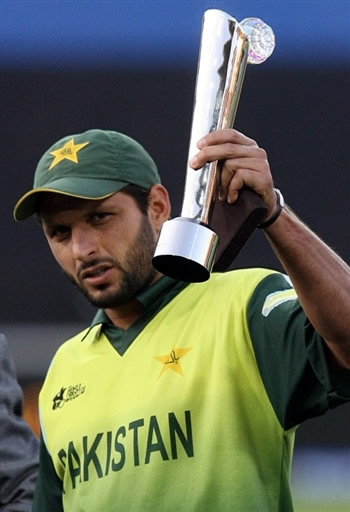
Shahid Afridi

Shahid Afridi Biography

Sahibzada Mohammad Shahid Khan Afridi born in Khyber Agency of the Federally Administered Tribal Areas, Pakistan), popularly known as Shahid Afridi is a Pakistani cricketer. Between 1996 and 2011, Afridi played 27 Tests, 325 One Day Internationals, and 43 Twenty20 Internationals (T20Is) for the Pakistani national team. He made his ODI debut on 2 October 1996 against Kenya and his Test debut on 22 October 1998 against Australia.

He is known for his aggressive batting style, and holds the record for the fastest ODI century which he made in his first international innings, as well as scoring 32 runs in a single over, the second highest scoring over ever in an ODI. He also holds the distinction of having hit the most number of sixes in the history of ODI cricket. Afridi considers himself a better bowler than batsman, and has taken 48 Test wickets and over 300 in ODIs. Currently Afridi is the leading wicket taker in the Twenty20 format taking 53 wickets from 43 matches.

In June 2009 Afridi took over the Twenty20 captaincy from Younus Khan, and was later appointed ODI captain for the 2010 Asia Cup. In his first match as ODI captain against Sri Lanka he scored a century however Pakistan still lost by 16 runs. He then also took over the Test captaincy but resigned after one match in charge citing lack of form and ability to play Test cricket; at the same time he announced his retirement from Tests. He retained the captaincy in limited-overs form of the game and led the team in the 2011 World Cup. Amongst his highlights while captaining Pakistan include leading the team to their first ODI series win in two-years. In May 2011, having led Pakistan in 34 ODIs Afridi was replaced as captain. Later that month he announced his conditional retirement from international cricket in protest against his treatment by the Pakistan Cricket Board (PCB).

Afridi is from the Afridi tribe of the Khyber Agency in the Federally Administered Tribal Areas and hails from a Pashtun family. He is married and has two daughters, Aqsa and Ansha.

In October 1996 at the age of sixteen Afridi was drafted into the ODI team during the four-nation Sameer Cup 1996–97 as a leg spinner as a replacement for the injured Mushtaq Ahmed. He made his debut on 2 October against Kenya, however he didn't bat and went wicketless. In the next match against Sri Lanka, Afridi batted at number three in the role of a pinch-hitter. In his first international innings, Afridi broke the record for fastest century in ODI cricket, reaching his hundred from 37 balls. The eleven sixes he struck also equalled the record for most in an ODI innings. Aged 16 years and 217 days, Afridi became the youngest player to score an ODI century. Pakistan posted a total of 371, at the time the second-highest in ODIs, and won by 82 runs; Afridi was named man of the match.

Two years after appearing on the international scene, Afridi made his Test debut in the third game of a three-match series against Australia on 22 October 1998. By this point he had already played 66 ODIs, at the time a record before playing Tests. He opened the batting, making scores of 10 and 6, and took five wickets in the first innings. He played his second Test the following January during Pakistan's tour of India; it was the first Test between the two countries since 1990. Again opening the batting, Afridi scored his maiden Test century, scoring 141 runs from 191 balls. In the same match he also claimed three wickets for 54 runs. After winning the first match by 12 runs, Pakistan lost the second to draw the series.

Shahid Afridi


Shahid Afridi


Shahid Afridi


Shahid Afridi


Shahid Afridi

Shahid Afridi

Shahid Afridi

Shahid Afridi

Shahid Afridi

Shahid Afridi

Shahid Afridi